TOP 10 Most Famous Castles in Germany
How many castles are there in Germany? According to historians, there are more than 20,000—more than in any other country of the Old World. Germany’s castles and fortresses are scattered from the misty shores of the Baltic Sea to the snow-covered peaks of the Bavarian Alps, from the Rhine Valley to Saxony. Among them, you’ll find Gothic towers, Baroque palaces, cliffside ruins, and 19th-century Romantic masterpieces.
Castles may look stunning in photos, but the real-life experience is far more impressive. In this article, we’ve gathered the most famous castles in Germany worth adding to your itinerary—along with practical tips on how to get there, ticket prices, and the best times to visit. To reach the heart of Europe without hassle, choose KLR рейси—a reliable carrier connecting Ukraine with Berlin, Munich, Frankfurt, and other cities.
Castles of Eastern Germany
The castles of Eastern Germany hide many treasures that tourists usually discover only when they travel here on their own. This region combines romantic Baroque palaces, medieval fortresses, and atmospheric ruins. Among the interesting but lesser-known sites is the Witches’ Castle in Thale (Saxony-Anhalt): according to folklore, this is where witches gather every year on Walpurgis Night, which still attracts tourists to witness this spectacle.
Schwerin Castle — an island gem of the Baltic coast
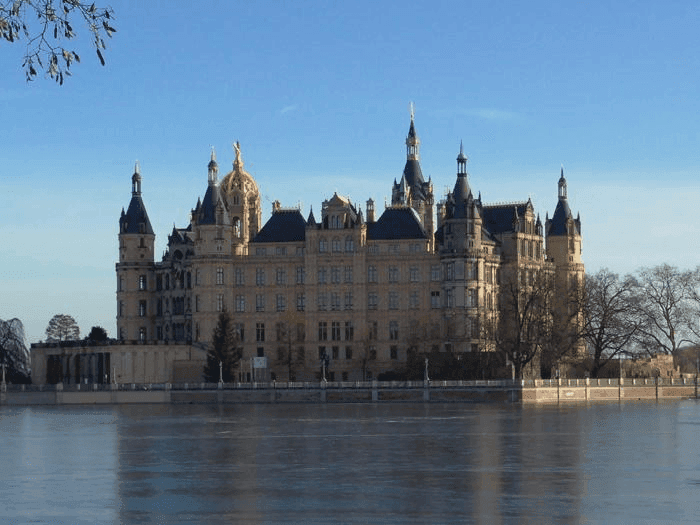
Schwerin Castle is one of the most recognizable palaces in Germany. It stands directly on an island in the middle of Lake Schwerin in the capital of Mecklenburg–Western Pomerania, about 3 hours from Berlin. Built in the 19th-century Romantic style, it resembles fairy-tale illustrations, although the real “Disney castle” in Germany is still Neuschwanstein. Schwerin impresses with its reflection in the water: the city surrounds the castle on all sides, and every morning mist rises above the lake.
Schwerin Castle: a short guide for travelers
-
Address: Lennestr. 1, 19053 Schwerin
-
How to get there: By train to Schwerin Hbf — approximately 2.5 hours from Berlin. Then take bus No. 5 or walk for about 20 minutes.
-
Opening hours: April–October: daily from 10:00 to 18:00. November–March: Tuesday to Sunday from 10:00 to 17:00.
-
Admission: Adult ticket — €8.50. Reduced ticket — €6.50.
-
Best photo spot: Schlossstraße promenade — a classic view of the castle over the water.
-
Lifehack: Arrive in the morning: there are still few tourists, and the light is best for atmospheric photos.
Moritzburg Castle — a Baroque hunting residence near Dresden
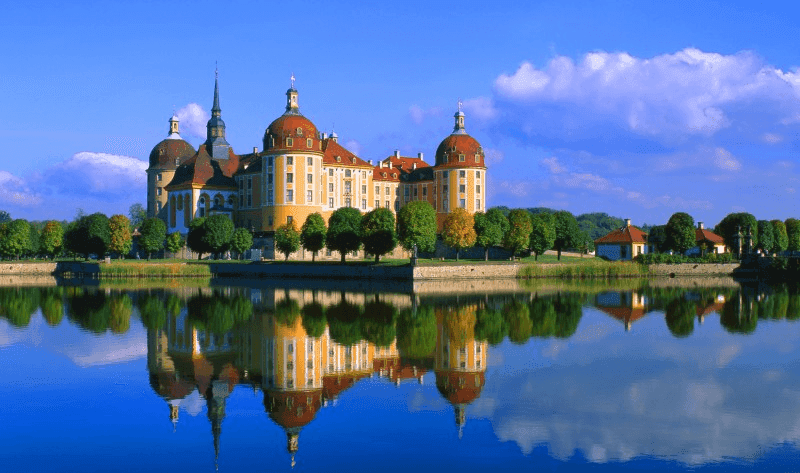
Moritzburg Castle is a luxurious residence of Elector Augustus the Strong, built in the 18th century as a hunting palace in the Baroque style. It is located 13 km from Dresden on an artificial island in the middle of a lake. In autumn, the castle is surrounded by a golden forest—one of the most famous autumn locations in Central Europe. This is where scenes from the fairy tale “Three Wishes for Cinderella” were filmed, which is why Moritzburg is often associated with the image of Sleeping Beauty’s castle. In December, there is an атмосферic Christmas market.
Moritzburg Castle: a short guide for travelers
-
Address: Schloßallee 1, 01468 Moritzburg
-
How to get there: From Dresden by tram No. 4 to the Hellerau stop, then by museum narrow-gauge railway or bus No. 326.
-
Opening hours: May–October: daily from 10:00 to 18:00. April and November: from 10:00 to 17:00.
-
Admission: Adult ticket — €8. Children under 16 — €5.
-
Best photo spot: The lakeshore opposite the main entrance — an iconic angle with the castle reflected in the water.
-
Lifehack: Choose weekday mornings — at this time there are fewer tourists from Dresden and more space for a calm visit and photos.
Castles of the Rhineland and the Moselle Valley
The Middle Rhine Valley and the Moselle River are a true treasury of medieval castles and fortresses. Among cliffs and vineyard-covered slopes, hundreds of structures from different eras stand here. On the Rhine, it is also worth noting Drachenfels (Dragon’s Castle, German: Drachenfels) near Bonn — one of the most visited ruins in Germany with a stunning panorama of the river. Not far from Frankfurt lies Königstein Castle in the Taunus Mountains — a well-preserved medieval fortress with observation towers. This region is also conveniently accessible with KLR routes.
Cochem Castle — a Neo-Gothic gem above the Moselle
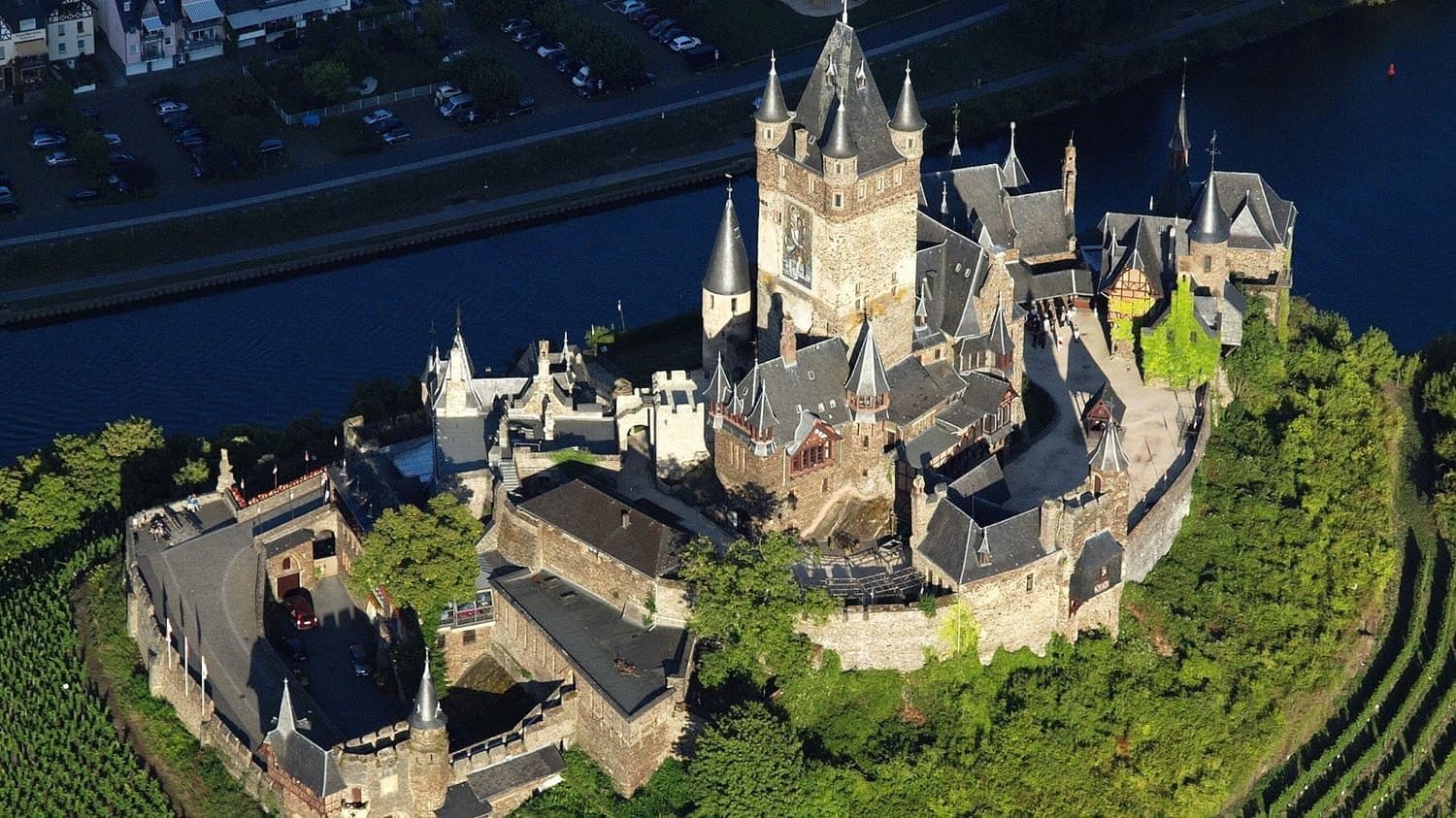
Cochem Castle (German: Reichsburg Cochem) is first mentioned in 1051, which makes it one of the oldest castles in the Moselle region. It stands on a rock above the town of the same name — it can be seen from any point in the valley. From the railway station, it is a 15-minute walk up a steep street or just a few minutes by shuttle bus. Tours run every 15 minutes and last about 40 minutes.
Cochem Castle (Reichsburg Cochem): a short guide for travelers
-
Address: Schlossberg 1, 56812 Cochem
-
How to get there: By train to Cochem (approximately 1.5 hours from Koblenz). From the station — walk uphill to the castle or take a shuttle.
-
Opening hours: March–November: from 09:00 to 17:00. Tours start every 15 minutes.
-
Admission: Adult ticket — €10. Children aged 6–17 — €5.
-
Best photo spot: The bridge over the Moselle River or the vineyard slopes opposite — a panorama where the castle looks most impressive.
-
Best time to visit: Spring (April–May) — the vineyards are blooming, the temperature is pleasant, and there are significantly fewer tourists than in the high season.
Eltz Castle — a knight’s fortress that was never destroyed
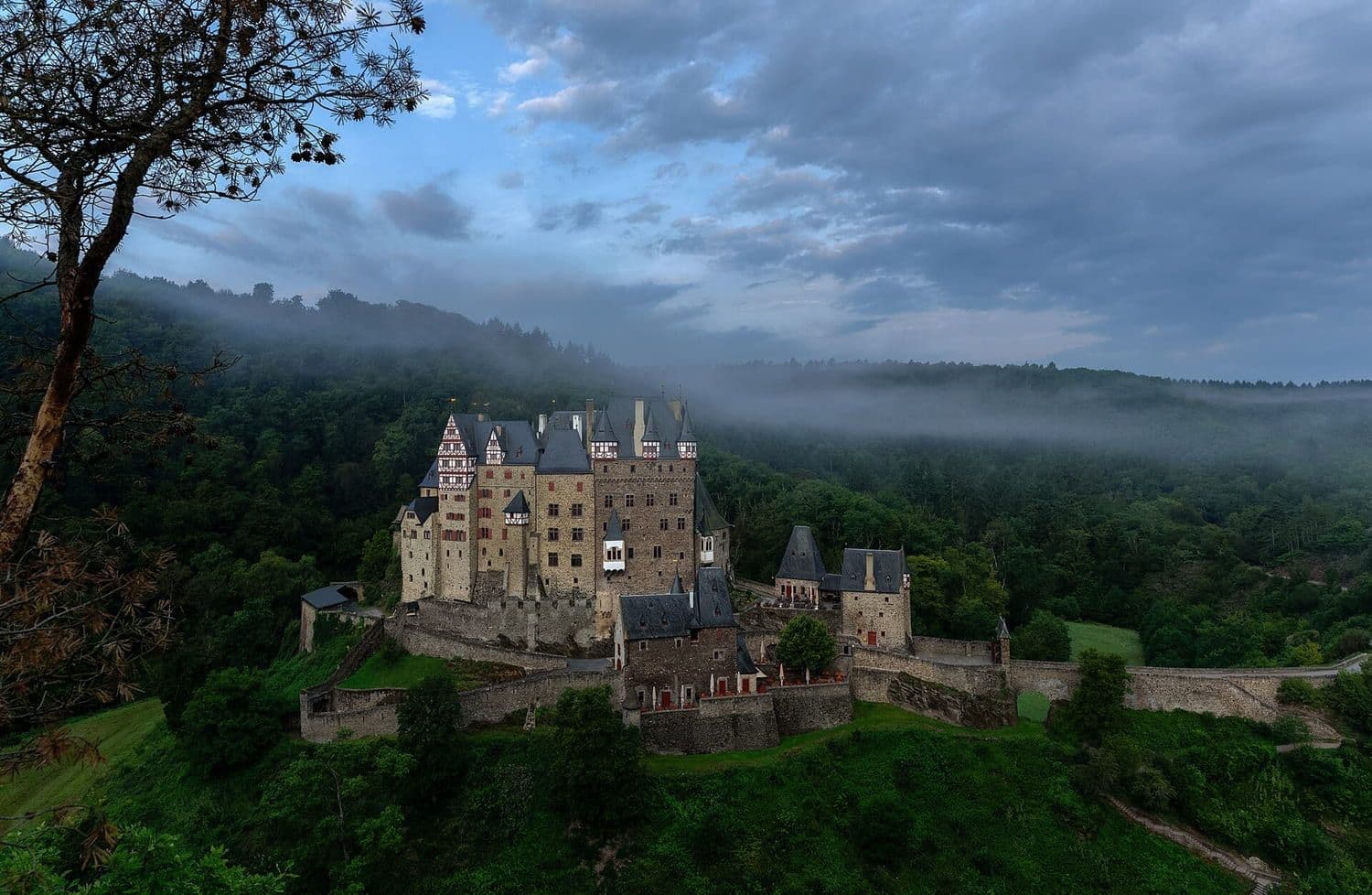
Where is Eltz Castle located in Germany? Burg Eltz is hidden in a forested canyon of the Elzbach River, 20 km from Koblenz in the state of Rhineland-Palatinate. It is one of the most unique medieval castles in Europe: it has never been destroyed and still belongs to one family — the Eltz family. Narrow towers, overhanging windows, inner courtyards, and stone passages — a classic example of a knight’s castle of the 13th–16th centuries.
Eltz Castle (Burg Eltz): a short guide for travelers
-
Address: 56294 Wierschem (reference point — parking near Münstermaifeld)
-
How to get there: By train to Moselkern, then follow a scenic forest trail for about 45 minutes on foot or take a paid shuttle minibus.
-
Opening hours: April–November: daily from 09:30 to 17:30. In the winter period, the castle is closed to visitors.
-
Admission: Adult ticket — €12. Children — €7.50.
-
Best photo spot: Eltz Viewpoint — from here opens a classic panoramic view of the castle surrounded by forest.
-
Note: Be sure to wear comfortable shoes — the route проходит along dirt paths with roots and slippery sections, especially after rain.
Frankenstein Castle — ruins with a legend about a monster
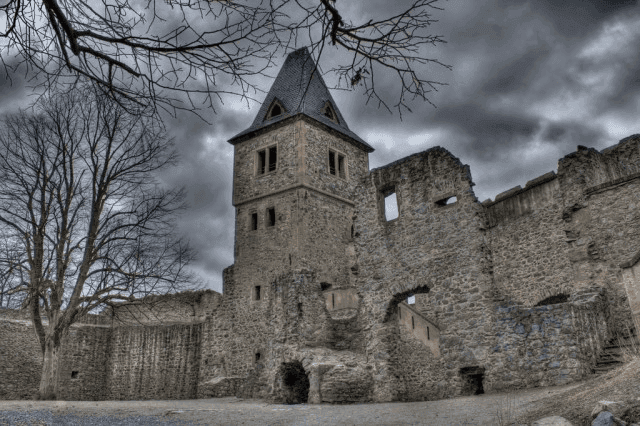
Frankenstein Castle is located on the hills of the Odenwald near Darmstadt, 30 km from Frankfurt. It dates back to the 13th century and is now picturesque ruins on the top of a hill. According to one legend, these places inspired Mary Shelley to write her famous novel. The castle is open for free visits during the daytime, and every year on Halloween, a large-scale themed celebration is held here — the most popular in the region. A convenient travel option: the KLR Lviv — Frankfurt route — and in a few hours you are in Hesse.
Frankenstein Castle: a short guide for travelers
-
Address: Burg Frankenstein, 64367 Mühltal
-
How to get there: By bus from Darmstadt or by a walking route of about 2 hours from the railway station.
-
Admission: Free access to the outer courtyard. There is a restaurant on the territory — convenient for resting after the climb.
-
Best photo spot: The observation tower with a panorama of the Rhine Plain — especially impressive at sunset.
-
Best time to visit: October — the period of large-scale Halloween events with an atmosphere of legends and mysticism. Summer — the ideal season for calm walks and photos above the valley.
Bavarian castles in the mountains: the kingdom of Ludwig II
Bavaria is a true paradise for fans of castle architecture. The most beautiful castles of the Bavarian Alps are concentrated here, built mainly by order of the eccentric King Ludwig II in the 19th century. Ludwig’s castle in Bavaria is an entire era in architecture. From Munich, any of them can be reached within a couple of hours by transport. If you are traveling from Ukraine, it is convenient to buy KLR tickets on the Lviv — Munich route and head to the castles directly from Munich railway station.
Neuschwanstein Castle — the most famous castle of Bavaria and all of Germany
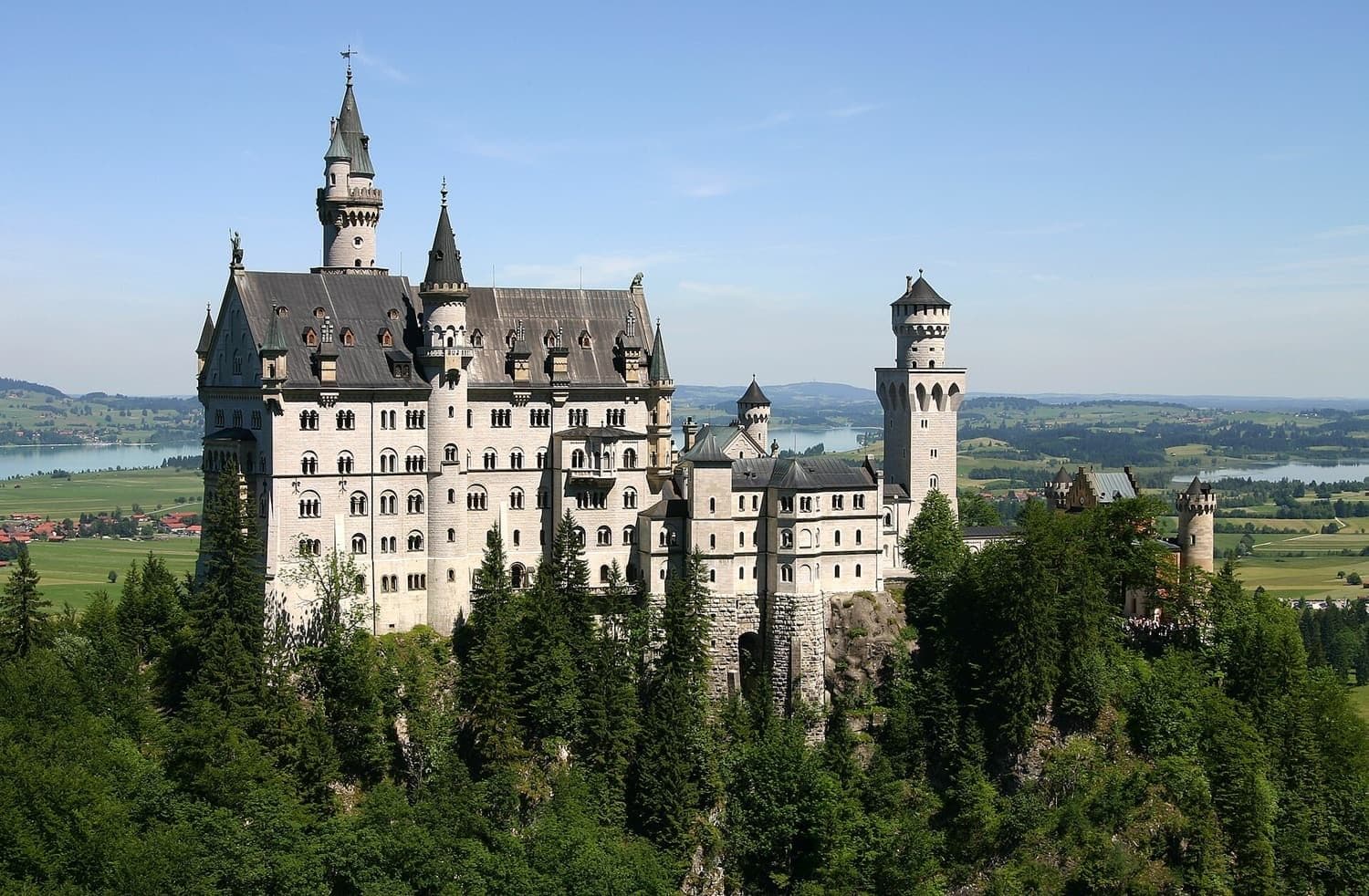
Neuschwanstein Castle is, first of all, one castle whose name has long become a symbol of the entire country. The Swan Castle in Bavaria was built by King Ludwig II in 1869–1886 on the cliffs above Lake Alpsee. The castle in the clouds is not a metaphor: on foggy days, Neuschwanstein’s towers literally disappear among the clouds above the Alps. This is where Walt Disney’s animators drew inspiration — unofficially, it is that very Disney castle. More than 1.4 million tourists arrive here every year, so tickets should be booked in advance.
Neuschwanstein Castle: a short guide for travelers
-
Address: Neuschwansteinstraße 20, 87645 Schwangau
-
How to get there: By train to Füssen (approximately 2 hours from Munich), then by buses No. 73 or 78 to Hohenschwangau. From there — about 40 minutes on foot or by horse-drawn carriage.
-
Opening hours: April–October: from 09:00 to 18:00. November–March: from 10:00 to 16:00.
-
Admission: Adult ticket — €15. Under 18 — free of charge. ⚠️** Important:** tickets must be booked online in advance.
-
Best photo spot: Marienbrücke Bridge — an iconic angle offering the most famous view of the castle.
-
Lifehack: Choose the first tour at 09:00 — fewer tourists and soft morning light for perfect photos.
Linderhof Castle — the most personal castle of Ludwig II
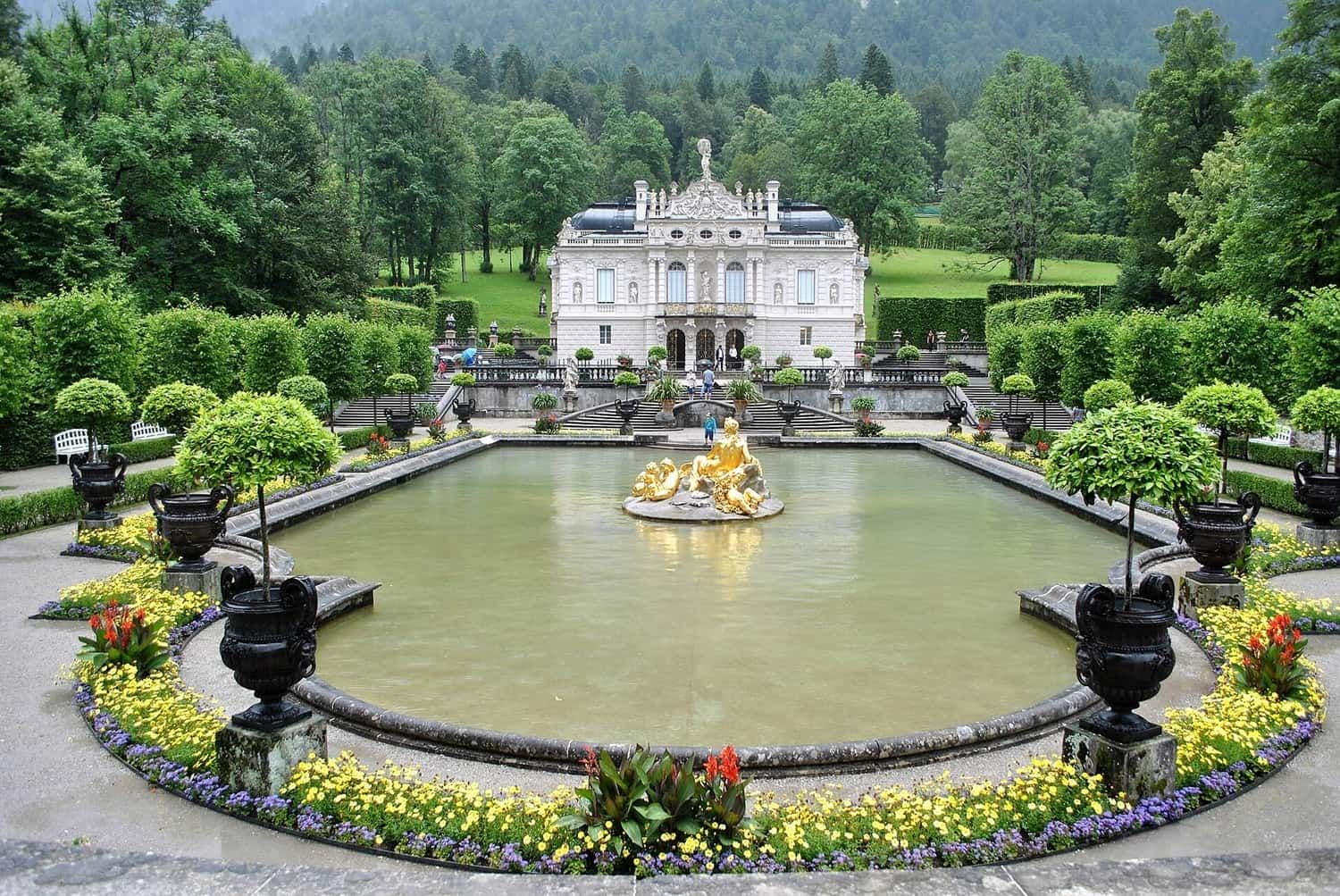
Linderhof is the smallest and most intimate of the king’s three castles. This mountain castle is located in a mountain valley 95 km from Munich, among the Bavarian Alps. It impresses not with its scale, but with its refinement: Rococo halls in gold, the 25-meter Neptune Fountain, underground grottos, and a regular park in the French style. Linderhof Castle is perhaps the most elegant in Bavaria.
Linderhof Palace: a short guide for travelers
-
Address: Linderhof 12, 82488 Ettal
-
How to get there: By train to Oberammergau (approximately 2 hours from Munich), then by bus No. 9622 to the Linderhof stop.
-
Opening hours: April–October: from 09:00 to 18:00. November–March: from 10:00 to 16:00 (the grottos are closed during this period).
-
Admission: Adult ticket — €10. Reduced — €9.
-
Restoration: Before the trip, it is worth checking up-to-date information — some halls or parts of the complex may be temporarily closed.
-
Best time to visit: May–June — the ideal period: the park is in full bloom, and the fountains operate at full capacity, creating the most impressive atmosphere for walks and photos.
Herrenchiemsee Castle — the Bavarian Versailles on an island
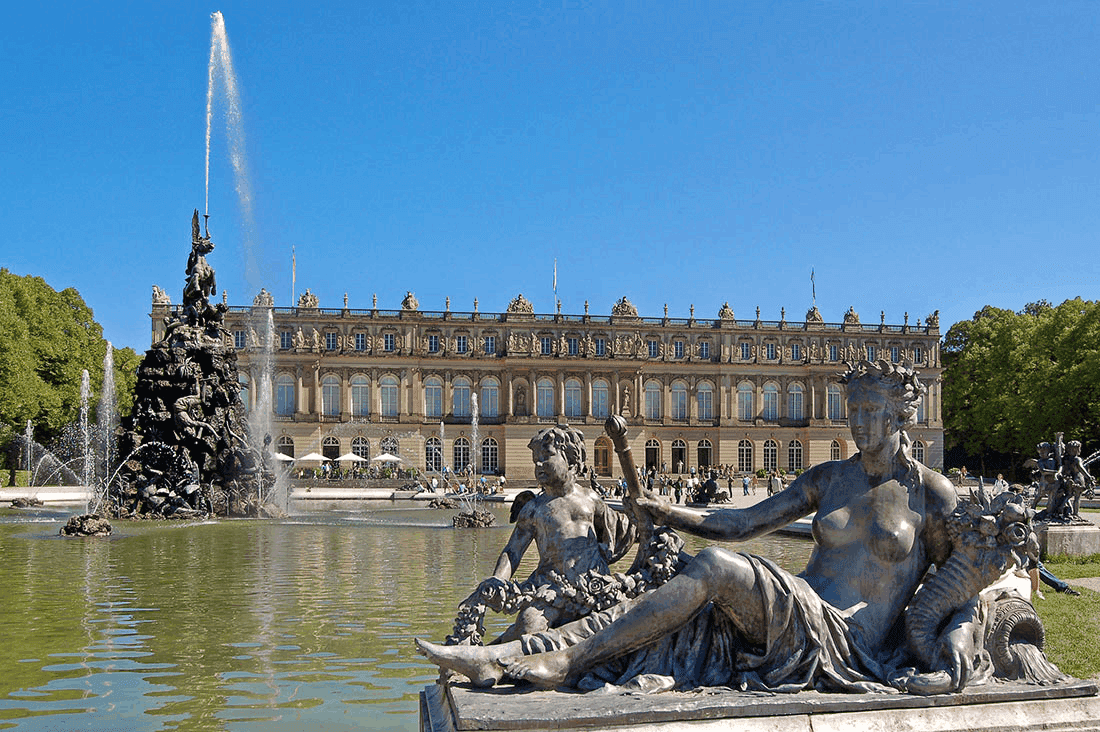
The third and most ambitious project of King Ludwig II is Herrenchiemsee Palace (German: Herrenchiemsee). It is located on the largest island of Lake Chiemsee, which locals call the “Bavarian Sea,” about an hour from Munich. The king admired the French “Sun King” Louis XIV, so he envisioned Herrenchiemsee as an exact, but even more luxurious copy of Versailles. Here you will find the longest Hall of Mirrors in the world and stunning formal gardens. As with other Bavarian castles, Munich—the main starting point—is conveniently accessible by comfortable KLR buses.
Herrenchiemsee Palace: a short guide for travelers
-
Address: Herreninsel, 83209 Herrenchiemsee
-
How to get there: By train to Prien am Chiemsee (approximately 1 hour from Munich). Then a 20-minute walk or a vintage train to the port of Prien/Stock, from where you need to take a boat to the island.
-
Opening hours: April–October: from 09:00 to 18:00. November–March: from 09:40 to 16:15.
-
Admission: Adult ticket — €10. Under 18 — free of charge. The boat is paid separately — approximately €10–12 round trip.
-
Best photo spot: Latona Fountain — the perfect symmetry of the palace, water cascade, and green alleys creates a “Versailles-like” effect.
-
Lifehack: Plan a full day. After visiting the palace, it is worth crossing to the neighboring island of Fraueninsel — fresh smoked fish and local marzipan are served there, making it a perfect gastronomic finale to the trip.
Famous castles of Brandenburg and Baden-Württemberg
The famous castles of this section cover two ends of Germany: Heidelberg in the southwest and Sanssouci in Brandenburg. Both are included in the rankings of the most popular tourist attractions in the country. Getting to Berlin — the starting point for Sanssouci — is convenient with the KLR Lviv — Berlin route, while for Heidelberg the KLR Lviv — Nuremberg route with a further transfer is suitable.
Heidelberg Castle — the largest castle and ruins of the Romantic era
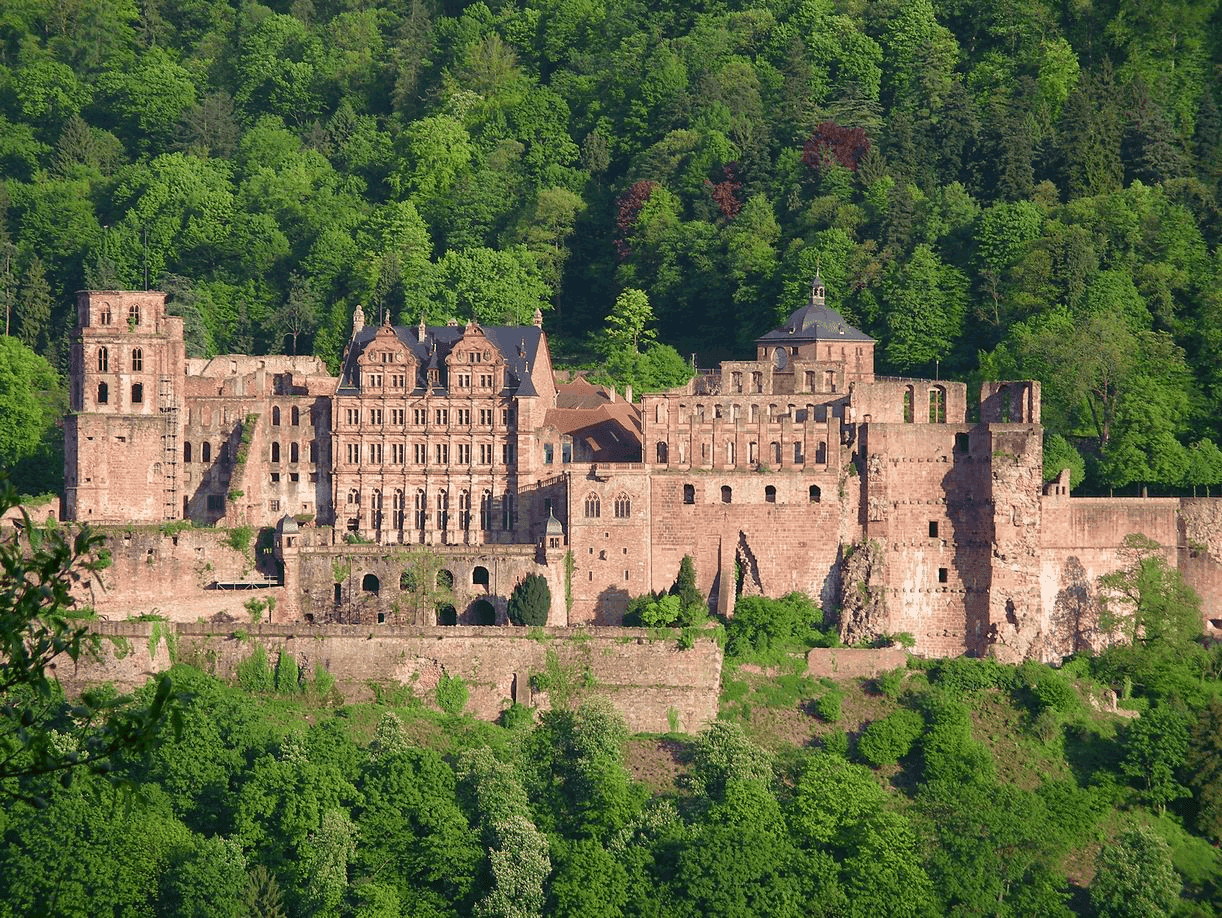
The largest castle in Central Europe is the ruins of Heidelberg Castle in Baden-Württemberg. They rise above the city and the Neckar River, and their silhouette has been a symbol of the university city of Heidelberg for over 500 years. The Gothic castle, built in the 13th–15th centuries, includes several buildings from different eras — from late Gothic to Renaissance. It is one of the most visited medieval castles in all of Central Europe.
Heidelberg Castle: a short guide for travelers
-
Address: Schlosshof 1, 69117 Heidelberg
-
How to get there: From Heidelberg Hbf, take tram No. 5 to the Rathaus/Bergbahn stop. Then you can go up by funicular or walk for about 20 minutes.
-
Opening hours: The castle complex is open daily from 08:00 to 18:00. The castle courtyard is accessible 24 hours a day.
-
Admission: A combined ticket, which includes the courtyard, terrace, and museum, costs €9. The funicular is paid separately — €5.
-
Best photo spot: Philosophenweg on the opposite bank of the Neckar. From here opens the most impressive panorama of the castle and the old town.
-
Lifehack: Stay until 20:00 — at dusk, the illuminated castle looks especially atmospheric.
Sanssouci Palace — the palace and park ensemble of Frederick the Great
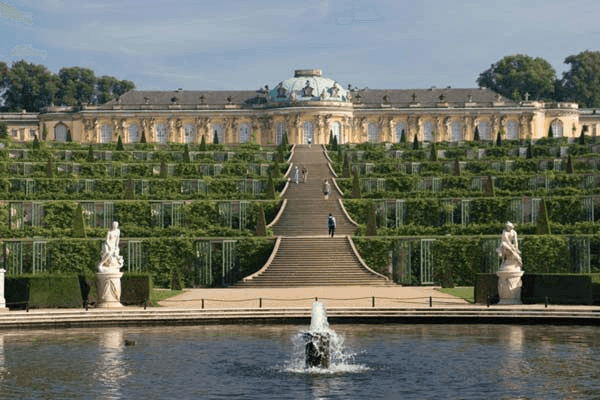
The Sanssouci Palace and Park ensemble (German: Sanssouci — “without worries”) is the favorite summer residence of the Prussian king Frederick the Great, built in the mid-18th century in Potsdam, 25 km from Berlin. The light Rococo style, terraces with vineyards, and a large park with fountains and pavilions together create a place with a unique atmosphere, completely different from the harsh medieval fortresses. Marienburg Castle near Hanover is another castle similar in spirit, which tourists often overlook.
Sanssouci Palace: a short guide for travelers
-
Address: Maulbeerallee, 14469 Potsdam
-
How to get there: From Berlin (Berlin Hbf) by regional trains RE1 or RE7 to Potsdam (about 25 minutes). Then by tram or about a 30-minute walk to the park.
-
Opening hours: April–October: Tuesday to Sunday, 10:00–18:00. November–March: 10:00–17:00. Monday — closed.
-
Admission: Adult ticket — €14. Reduced — €10. Online booking: Stiftung Preußische Schlösser und Gärten Berlin-Brandenburg
-
Best photo spot: The terrace with vineyard steps — a classic view of the palace from the park side.
-
Lifehack: Choose the Sanssouci+ ticket — it gives access to all park sites and allows you to see the maximum in one visit.
What tourists need to know: tips and precautions
It’s better to prepare in advance — then the beautiful castles of Germany will give you unforgettable impressions without unpleasant surprises. The best castles always have their own specifics: terrain, seasonality, and queues. Book tickets online — especially for Neuschwanstein and Sanssouci. Queues on-site can take 2–3 hours.
- Wear comfortable shoes. Almost everywhere there are cobblestones or forest paths. High heels are a bad choice for castles.
- Check winter opening schedules. Eltz Castle and the Linderhof grottos are closed in winter. Some interiors may also be closed for restoration — check official websites.
- The best time for photos is early morning or evening. Famous castles are crowded with tourists during the day.
- Combine several castles in one trip. Neuschwanstein and Linderhof — in one day; Eltz and Cochem — in a day trip from Koblenz.
- Some sites are free — Frankenstein Castle (outer area), Drachenfels (ruins access). Check current conditions on official websites. Advance planning of details is the key to ensuring that your castle tours in Germany go at the highest level. From choosing comfortable shoes to a well-planned route — all of this creates the space for an unforgettable trip. All that remains is to choose reliable bus routes that will comfortably take you to the main tourist gems of Bavaria, the Rhineland, or Brandenburg.
Plan your castle trip with KLR
Medieval castles and Gothic fortresses of Germany are not just tourist attractions — they are living history. To get to Berlin, Munich, Frankfurt, or Nuremberg — the starting points of all four castle routes — choose proven KLR routes. The famous castles of Bavaria, the Rhineland, and Brandenburg will become closer than they seem: buy your ticket at klr.com.ua today — and discover the most famous castle in Germany and dozens of other architectural masterpieces of Central Europe!