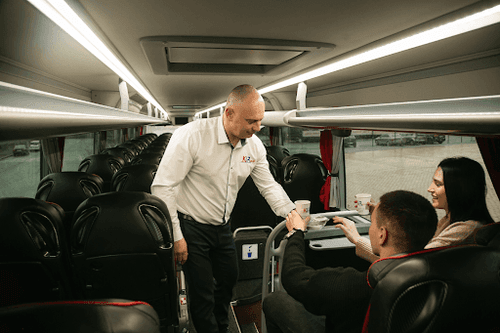
Transporting animals on the bus
Passengers often take their pets with them on trips. Therefore, below we answer the most typical questions from KLR Bus passengers regarding the rules for transporting animals on board our buses.
What is the cost of transporting animals on KLR Bus routes?
Animals weighing up to 8 kg are allowed to travel at full ticket price with an assigned seat. If the animal weighs more than 8 kg, we do not allow it on board.
What are the rules for transporting animals on KLR Bus routes?
The animal must remain in a carrier with a hard bottom during the entire trip;
The animal must have a set of documents for crossing the border and be healthy;
The transportation of the animal must be paid for;
The animal must have a separate seat next to the owner.
What set of documents does a passenger need for an animal to cross the border?
For cats, dogs, and ferrets:
Document confirming the presence of a microchip in the animal.
Valid rabies vaccination, done no earlier than 21 days before entering Poland.
Veterinary passport with all scheduled vaccinations, microchip information, a photo of the animal at 12 months old, and information on parasite treatment.
Health certificate.
Certificate of rabies antibody test. The validity period of the certificate is 3 months from the moment of crossing the border.
Form VET-1 or VET-1 (CIS).
International certificate. Issued free of charge at the border at a special veterinary point. The VET-1 certificate is required for obtaining it. Deworming and insect acaricide treatment conducted no earlier than 48 hours before departure, confirmed by a corresponding stamp in the passport.
Document confirming that the animal is not of breeding value.
Certificate of compliance for the animal container. It must meet all IATA standards.
For rabbits, hamsters, mice - no requirements or documentation are established.
Important!
For violation of these rules, the border services of the destination countries may:
Return the animal to the country of departure;
Quarantine the animal or euthanize it.