International transportation market 2025: demand growth and new opportunities
In 2025, instead of chaotic border crossings, clear logistics came into play. Data from KLR Bus confirms that bus transportation has adapted to the new conditions, with routes becoming regular and predictable. Now, these trips are a normal part of life for Ukrainians who live between two countries.
This is evident both in everyday behavior and in raw statistics: according to data from Opendatabot and “Ukrinform” (based on information from the State Border Guard Service), an average of 2.35 million border crossings are recorded every month. People continue to travel home actively and are increasingly planning their trips in advance, relying on a stable schedule and reliable routes.
Portrait of a Passenger in 2025: How Often They Travel and Why
With stable connections, international buses have become a familiar mode of transport for Ukrainians. A trip abroad is no longer seen as something unusual — people simply plan their affairs, combining life in Ukraine and EU countries. A survey by KLR Bus shows how often passengers traveled in 2025:
-
59.9% — travel 1–2 times a year (usually trips to relatives during holidays or vacation);
-
25.1% — travel regularly 3–5 times a year;
-
9.9% — used international routes for the first time;
-
5.1% — travel constantly.
These figures confirm that passengers have a specific purpose. For most (78.1%) it’s visiting family or friends. Tourism ranks second (9%), indicating that demand for leisure travel is gradually returning. Other passengers are traveling for business, education, medical treatment, or to catch flights at foreign airports. With a clearer travel rhythm, planning has become easier — and the market quickly responded.

Growth of Transportation in 2025: Key Changes and Trends
The number of international bus trips in 2025 increased by 27% compared to 2024. This is also supported by the overall mobility statistics: Ukrainians are crossing the border steadily and consistently, without sharp dips or spikes. On this background, passenger behavior has changed: trips are now planned in advance, with convenient connections chosen and routes selected based on predictable schedules. The current figures confirm that the market has matured into a system that helps millions of Ukrainians maintain constant contact with home.
Migration in the EU and Routes: Where Ukrainians Live and How It Changes Routes
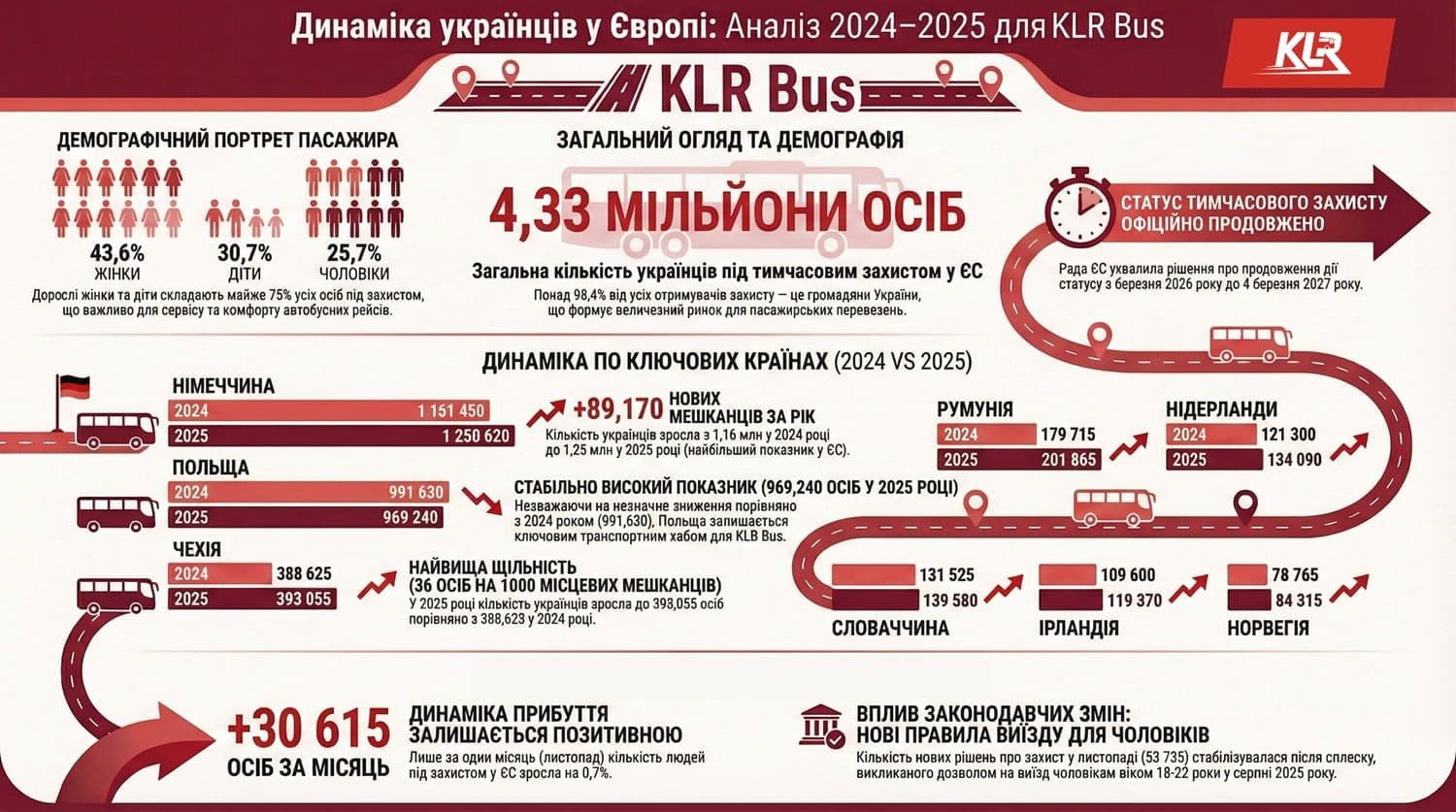
The growth of the market quickly revealed its geography: routes in 2025 are directly influenced by where Ukrainians have relocated. For transport companies, data from Eurostat on people under temporary protection provides insights into where demand for routes will be the highest. Currently, the largest number of our citizens are concentrated in three countries: Germany (1,218,100 people), Poland (1,008,885 people), and the Czech Republic (389,310 people).
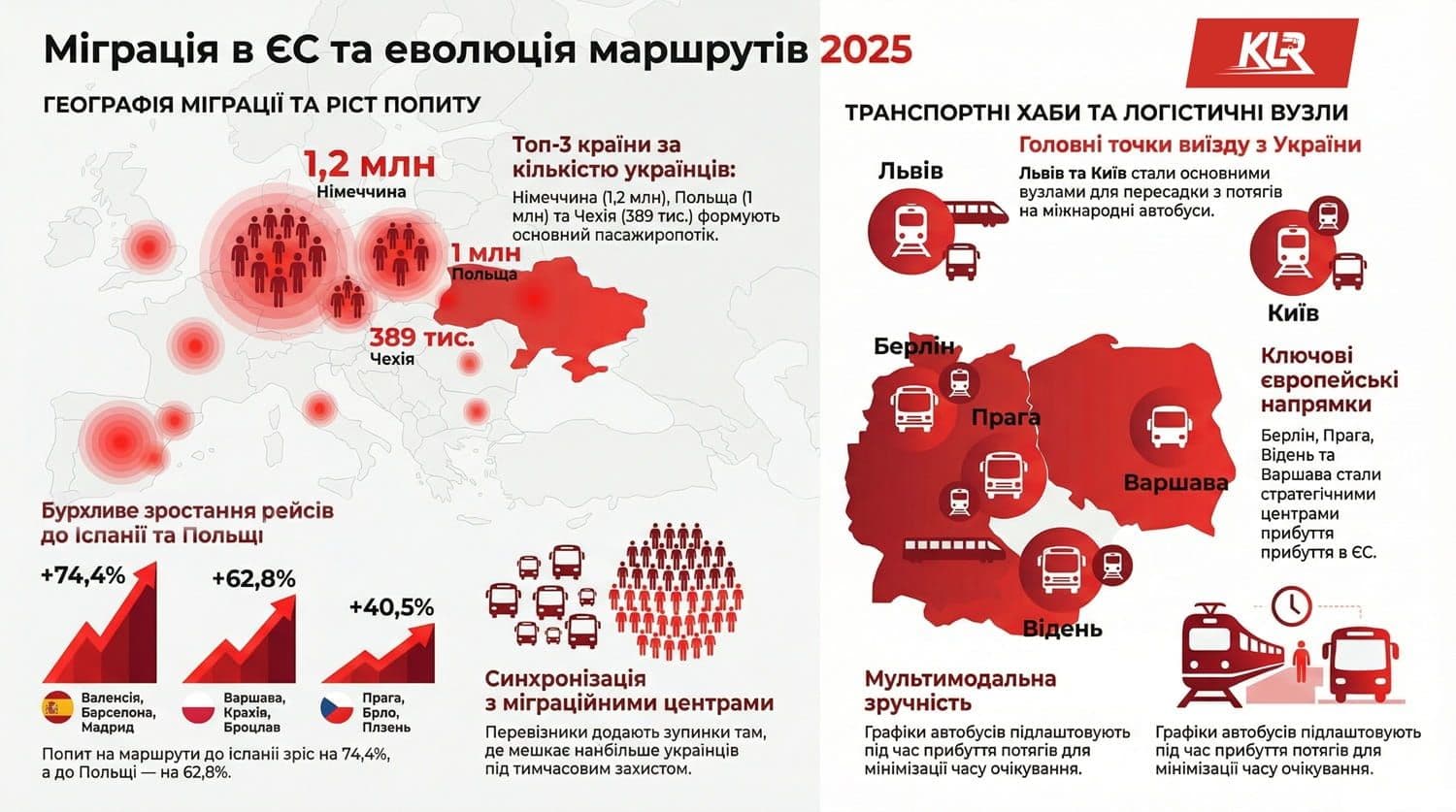
A significant number of Ukrainians also live in Spain (246,995 people), the Netherlands (130,495 people), and Austria (88,855 people). This migration pattern has directly influenced the route network: transport companies are adding routes and adjusting schedules to countries with consistently high passenger flows, ensuring convenient connections to regions where the most relatives and friends of Ukrainians now live. This logic is clearly visible in ticket sales structure.
Transport Hubs in 2025: Key Departure Cities from Ukraine and Arrival Points in the EU
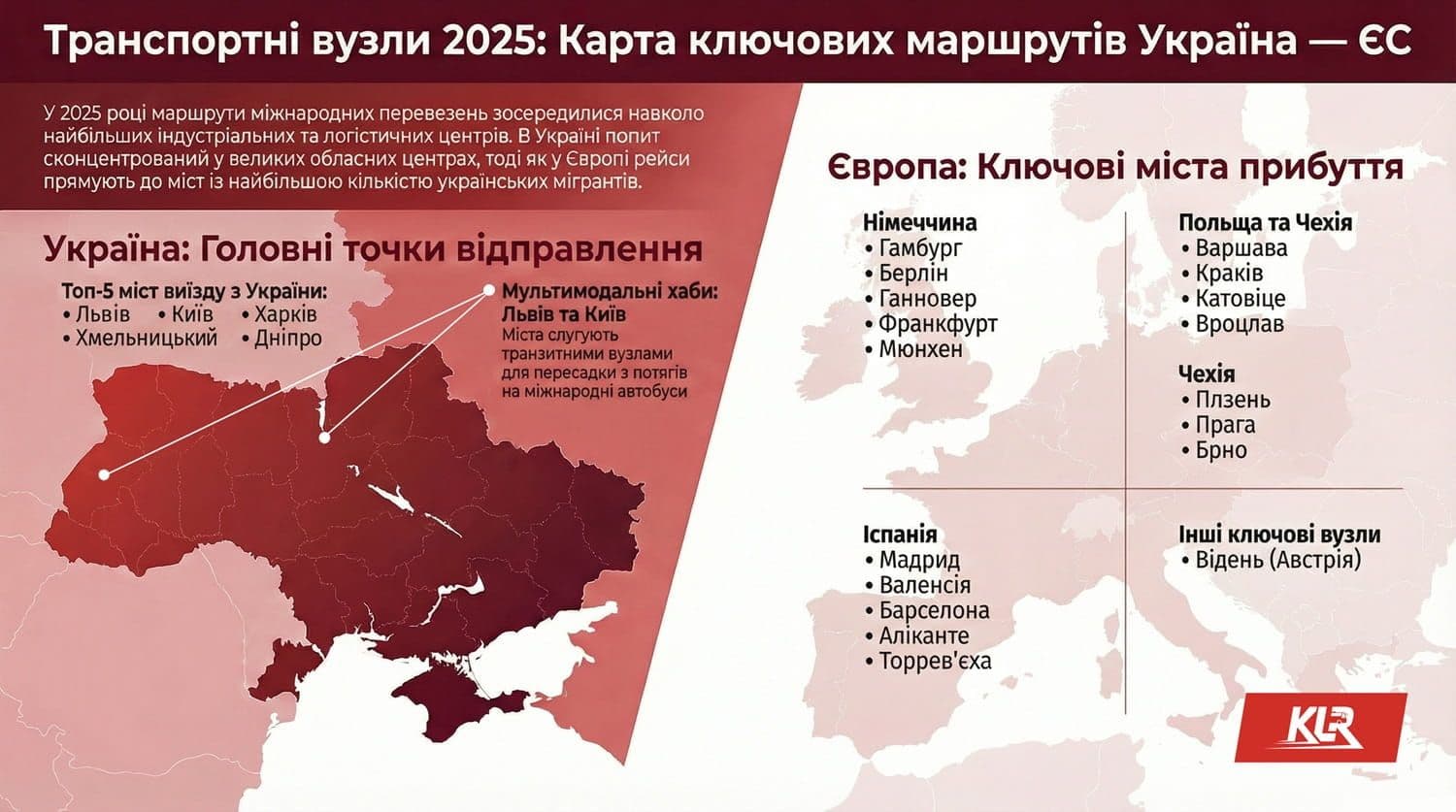
Once demand solidified in specific countries, routes naturally concentrated around the largest cities in each country. In Ukraine, the main transfer points became Kyiv and Lviv, where passengers transfer from trains to international bus routes. To ensure maximum comfort in these cities, we are developing our own infrastructure. Specifically, our modern terminals in Lviv and Khmelnytsky were built specifically for passenger convenience, offering European-level service while waiting for the bus. The Khmelnytsky terminal became a model for this approach, and now the same functionality is available to guests in Lviv as well. This allows the transfer process to be quick, safe, and as pleasant as possible for every customer. Thanks to our extensive coverage, we are able to collect and analyze data on the most popular routes across the country. The statistics below are based on internal analytics from our company, reflecting the real distribution of passenger traffic. The most popular departure cities are:
-
Lviv;
-
Kyiv;
-
Kharkiv;
-
Khmelnytsky;
-
Dnipro.
As for Europe, the passenger flow is distributed among large industrial centers where most Ukrainians now live and work. So that people don’t have to make unnecessary transfers within countries, we open new stops and add routes to cities with the highest demand. The key arrival cities in Europe in 2025 include:
-
Germany: Berlin, Hamburg, Munich, Hannover, Frankfurt.
-
Poland: Krakow, Warsaw, Katowice, Wroclaw.
-
Czech Republic: Prague, Plzen, Brno.
-
Spain: Valencia, Barcelona, Madrid, Alicante, Torrevieja.
-
Austria: Vienna.
This concentration allows us to avoid spreading our resources too thin and adjust bus schedules to align with train arrivals in Ukraine. We continuously add new stops to routes, so passengers can reach their destination as quickly and easily as possible.
Trends for 2026: How the International Transportation Market Will Change
After the market took shape in 2025, the next step is its further systematization. In 2026, the international bus transportation market is likely to move toward even greater regularity: more frequent routes with precise scheduling, strengthening of routes to countries with the highest concentration of Ukrainians, and more trips tailored to practical passenger scenarios — family visits, train connections in Ukraine, and transfers to European airports. At the same time, the role of digital services and process quality will increase: transparent ticket exchange conditions, clear baggage and pet transport rules, stable support, and early booking, as competition increasingly focuses not only on price but also on trust and comfort. As a result, the winners will be transport companies that invest in technical reliability, punctuality, and predictable service — this is what builds repeat trips. The implementation of these trends can already be seen in the example of certain transport companies operating in the international market.
2025 Results for KLR Bus: Infrastructure, Service, and Social Projects
To illustrate how these market changes are working in practice, it is worth looking at the example of KLR Bus: the company operates international routes from various regions of Ukraine and has accumulated a large amount of operational data and passenger survey results for 2025, which complement the general market picture. The year 2025 was a period of expansion for KLR Bus, which passengers felt firsthand. The company also responded to practical requests, such as the ability to travel with pets — over the year, more than a thousand animals were transported.
A particular focus remained on working with regular customers. KLR Bus’s loyalty program now has 162,943 members — for many, this is a convenient way to plan trips in advance and receive service with clear rules. At the same time, the year 2025 showed that the success of KLR Bus lies not only in the volume of transportation but also in supporting the country. The company allocated about 1 million UAH for the needs of the Armed Forces of Ukraine, donated a vehicle to the front line, and provided 3,312 free rides for military personnel. In the end, the year confirmed that service, development, and responsibility can work together.
